

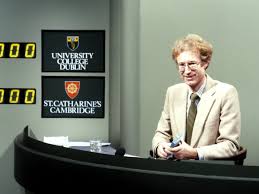
University Challenge has been on our television screens since 1962. I recall watching it a few years later, and as parodied in The Young Ones, always believed that the two teams sat one on top of the other. The original question master was the wonderfully named Bamber Gascoigne, who was a central casting pick for an academic. His opening line of every segment “And here’s a starter for ten” became a catchphrase known well beyond the audience for the show.
In 1962 there were 23 universities in the United Kingdom. If they were all entered into the competition, the programme would only have lasted about six weeks. It was originally broadcast on ITV, and would draw in an audience for advertisers that was hard to attract, so to get more entries, and more shows, the individual colleges in Oxford and Cambridge were invited to participate. These colleges do not award degrees, the Oxbridge universities do that, but they do have some autonomy and run classes.
University Challenge ran on ITV for 917 episodes, between 1962 and 1987, it then went into hibernation until the BBC picked it up in 1994 and Jeremy Paxman became the question master. It was no longer a commercially driven programme, as, while it was still made by Granada Television, it was funded from the licence fee.
Not only had the broadcaster changed, but so had the landscape of education in the United Kingdom, and there were now over 150 universities, the growth being mainly delivered by the Education Act in 1992 whereby what had been Polytechnics transformed into Universities, hence the Ulster Polytechnic became the Ulster University. One of the main drivers of this was to remove the class divisions in education and level up the degrees awarded.
As a result there were now plenty of universities to participate in University Challenge. A level playing field could be created to align with the change in status for polytechnics, and they could enter, but also be visible to the wider public and attract potential students.
But.
This didn’t happen.
Despite there no longer being a need to expand the numbers, n a typical year, around a third—sometimes nearly half—of University Challenge teams come from just two universities, represented by their individual colleges. There are twenty eight entrants, and of those one third to almost a half will be Oxbridge.
In other words two Universities, even on a level playing field, Oxford and Cambridge have up to a 50% chance of winning. In reality, their advantage is structural—and the results reflect it. Having guaranteed places they can also devote time to practicing and learning the specific topics that will come up in the questions.
Which brings me to another bias. The subjects of the questions.
Not only has the number of universities expanded exponentially, but so have the subjects taught, but to watch University Challenge you would be hard pushed to know.
Take music as an example. In 1962 one could forgive the question setters for limiting the music questions, where the audio is played, to classical and popular. 1962 was before the Beatles and every other genre of music that has evolved since, from rock, ska, reggae, soul, jazz (which has multiple subsections), hip hop, easy listening and many more that I am too old to know about. But in 2026 the questions are predominantly classical, with a clip played and the name of the composer asked. Do we really think that young intelligent students sit around listening to classical music to the exclusion of others, or is it simply that classical is seen as highbrow and therefore “better”, and those that listen to it reflect those attributes? Is being an expert on house music less worthy that of baroque classical? The same applies to the second picture round. In almost every episode the contestants will be shown an old painting and asked who painted it, and it will often be Caravaggio, Botticelli or Titian. That is a revision exercise. Go online and look at famous paintings and who the artist was. In 1962 the underlying question was “have you been to a museum or art gallery lately and if not why not?” well before the idea of the internet was even in science fiction.
The growth in the subjects for education has not been allocated for at all. They are still stuck in ’62. Of course this is not absolute, but traditional subjects, taught in Oxbridge for ever, still make up the vast majority of questions. Polytechnics which became universities had a more vocational ideology, and traditional universities have added a much wider variety of degrees.
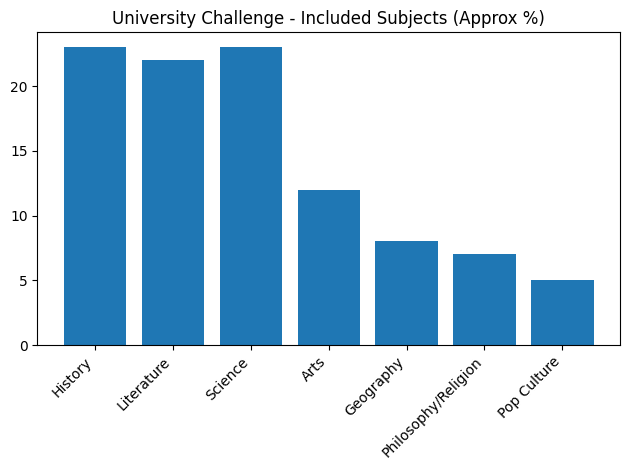
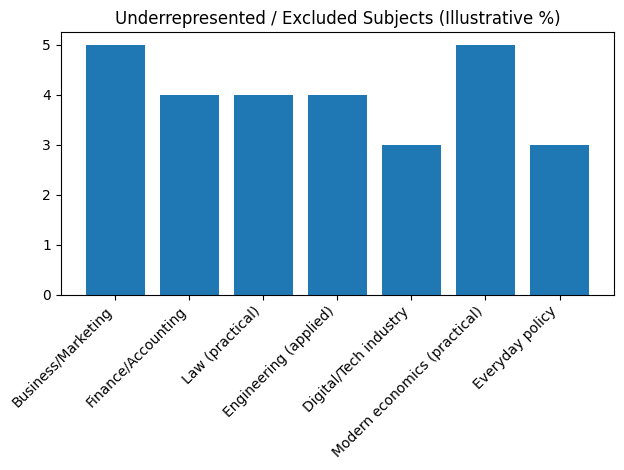
So you get the gist of the issue. The BBC broadcasts a programme that promotes the notion that Oxbridge universities are superior to all others. They win more regularly, but as we have noted they have multiple teams in the competition. Having multiple teams suggests that they must have many more clever people and need to facilitate them, but this is nonsense. The subjects also come into play as the Oxbridge universities recruit 30-35% of their intake from public schools where, yes, you guessed it, more classical curricula still pertain, the very subjects that are core to the questions asked.
The other affect of having so many Oxbridge teams is that it limits the number selected from the other 150 plus universities, none of which are guaranteed a place (you could make a case for there being no Oxford or Cambridge, let alone multiples). how are they selected? Well, it is not on merit. They are apparently chosen by the production company based on their make up and diversity. I have personal knowledge of a team that was heading to the broadcast section, only to be removed when their captain, who as disabled, had to pull out due to illness. The team was dropped.
So Oxford and Cambridge are guaranteed multiple slots, and every other university may or may mot get a team entered. Here are a few of the top universities listed in the Guardian that do not get on air every year. St Andrews, Durham, Warwick, LSE.
So why has the BBC not changed University Challenge? Who benefits?
First and foremost Oxford and Cambridge. Universities are businesses, now more than ever, and are competing for income from multiple sources. These include students, with overseas being a huge source of revenue, for both under and post graduates, so the brand is vital in attracting applicants. These two universities share almost 25% of the total income from research which is approximately £2 billion per annum. The other 80% is shared between nearly 200 other institutions. Again the brand working hard.
Other beneficiaries of the ongoing positioning of Oxbridge are the the graduates and academics. Saying Oxford or Cambridge to anyone produces a positive reaction and an immediate respect, as well as belief that the person is cleverer than the normal student. In an interview there will be an immediate bias, not simply because the person is deemed smart, but it reflects well on behalf of the employer that they employ smart people and that smart people choose to work there.
Then you look at who broadcasts University Challenge. The BBC. 5% of all employees at the BBC went to Oxbridge. Fine. But approximately 35% of the senior executive team were educated in those universities. They have a lifetime of belief in the superiority of their education, and they certainly want that to remain so they can justify both their own positions, but also continuing to employ people from a limited pool.
University Challenge is an integral part of the establishment, along side many others in the media. From a pool of 1% of the population around 20-30% of high profile media figures come from Oxbridge, particularly in the areas of TV presenters, news anchors, political commentators, and documentary makers. The same gene pool may produce different characteristics but the core attributes come from the same very limited educational environment, ivory towers set in historical locations being promoted on air every day.


Leave a Reply